

If you are considering a custom home there are numerous decisions you have to make including what type of logs and timbers to build with? When building a custom home, it’s very important to select the best wood species for your project in order to maximize overall durability, while minimizing cost. Today we are going to look at two of the most popular types of cedar, Western Red Cedar and Alaskan Yellow Cedar. Known for their rich aromatic and being highly decay resistant, we will look at the advantages and disadvantages of building with each and the costs associated.
Western Red Cedar
 A premium slow growth timber and the most abundant cedar tree available in Western Canada, Western Red Cedar primarily grows in British Columbia and is our preferred choice for many of the custom log home and timber frame structures. Although it is one of the lightest in weight of all commercially important softwood species, Western Red Cedar is very decay resistant and it can yield a larger variety of dimensional lumber. Its abundance and favorable properties make it the dominant choice for building and exports, especially in Europe since it does not have to be heat treated before exporting; and being twice as stable as other softwood species. Western Red Cedar is highly durable and weather resistant. Its natural oils are insect and decay resistant, and left in its natural state it remains beautiful and aesthetically pleasing. Western Red Cedar dries readily with very little shrinkage and has excellent working qualities, machining to a smooth, satiny finish.
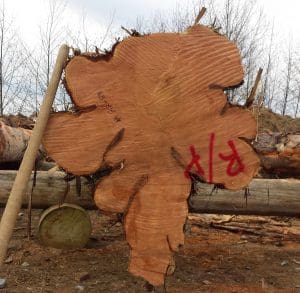 Rich in texture, with a unique tactile grain, Western Red Cedar combines visual harmony with stability and durability, making it the common choice for a number of projects such as: siding, decks, fences, planters, screens, and garden furniture. Given its ability to withstand the elements, if you are looking to build your log or timber frame home in an area where extreme weather dominates we would be most inclined to recommend Western Red Cedar.
Western Red Cedar is also known for their flared butt ends that offers a unique character to many log homes both inside and outside. If you like this type of look and feel for your home, western red cedar may be the best type of timber for your home. If you don’t particularly like this look you can still use red cedar without flared ends. The variety that this timber offers us is another reason why we love using this material to build our Western Red Cedar Log Homes.
Alaskan Yellow Cedar (also known as Cypress)
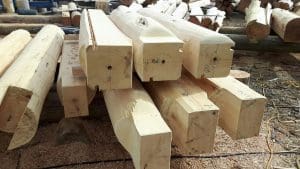 The slow growing Alaskan Yellow Cedar is a tough, solid tree and the hardest known cedar in the world, while also boasting exceptional longevity. Due to its straight grain and yellow colour, Yellow Cedar wood is very valuable commercially. It is used extensively for paddles, boat building, as well as other exterior projects such as bridges, decking, stairs and landscaping. Similar to the Red Cedar, it is highly decay resistant and strongly aromatic when freshly cut, due to its natural oils. However, it’s interesting to note that the Alaskan Yellow Cedar is not in fact a cedar tree, but a cypress tree.
Considerably harder when dry than most commercial softwoods, and therefore much stronger, AYC has excellent strength and wear properties as well as great impact resistance. It is suitable for all types of joinery and carpentry due to its appearance, durability and easy working characteristics. This wood is so easy to work that it has become prized for applications such as joinery and carpentry, decorative panelling, furniture, mouldings and cabinetwork. It also withstands constant wear and load impacts without forming ridges or splitting, and does not splinter.
One of the disadvantages of Alaskan Yellow Cedar is the ability to sourcing large diameter high quality wood. For this reason many builders choose red cedar over yellow cedar.
Cost Comparison: Western Red Cedar vs Alaskan Yellow Cedar
This chart compares the average cost of Western Red Cedar vs. Alaskan Yellow Cedar per square foot depending on the style of custom home you build:
| Western Red Cedar |
Western Red Cedar w/Flared Ends |
Alaskan Yellow Cedar | |
| Full Scribe | $55-$75 | $65-85 | $50-$60 |
| Post & Beam | $45-$65 | $45-$75 | $40-$55 |
| Timber Frame | $55-$75 | N/A | $40-$55 |
*The above costs are an estimated average and can change.
We hope this has given you a better understanding of the differences between the two cedar options available, and why we choose to build Western Red Cedar Log Homes. If you have any specific questions we would be happy to discuss them. Please feel free to email us: info@artisanlog.com.
If you would like to know more about the cost associated with building your custom log home you may want to read these articles as well:
- What are the best logs for building my log home?
- How Much Do Log Homes Cost
- How Much Does It Cost To Transport and Export a Log Home
- The Difference Between Timber Frame, Post and Beam and Full Scribe Log Homes
Frequently Asked Questions
Which is better for a log home: western red cedar or yellow cedar?
For most log homes we recommend western red cedar: it is lighter, very stable and easier on the budget while still being highly rot-resistant. Choose Alaskan yellow cedar when you want maximum hardness and durability and the budget allows, it is denser and longer-wearing.
Is western red cedar or yellow cedar more expensive?
Alaskan yellow cedar costs more, often noticeably, because it is denser, slower-growing and harder. Western red cedar gives you most of cedar’s benefits at a lower price, which is why it is the more common choice for log walls.
What is the best wood for building a log home?
Cedar is the benchmark for log walls thanks to its natural oils, rot resistance and stability. For structural post & beam work we also build in Douglas fir for its strength. The best species comes down to your climate, budget and the look you are after.
Does cedar rot or attract insects?
No, that is cedar’s biggest advantage. Both western red and yellow cedar contain natural oils that resist decay and insects without chemical treatment, a major reason a cedar log home lasts.